

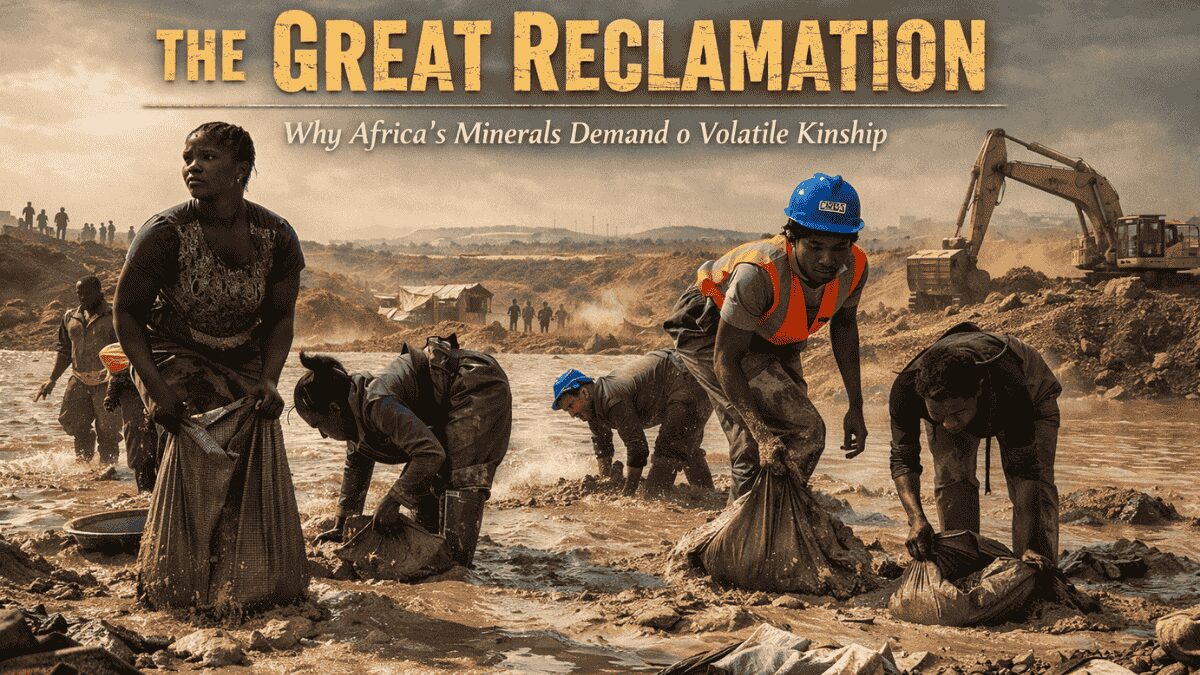
For centuries, the narrative of Africa’s natural resources has been defined by external extraction and domestic deprivation. From the tragic “Scramble for Africa” in the late 19th century to the post-colonial struggles over oil and gold, the continent has often been a spectator to the removal of its own wealth. Today, a new chapter is being written—not with colonial flags or naval blockades, but through high-stakes boardrooms and a global hunger for the critical minerals Africa holds in unparalleled abundance.
As the world pivots toward a net-zero future, the minerals found across the continent—lithium, cobalt, copper, and rare earth elements—have become the new “green oil.” However, this modern-day gold rush presents a double-edged sword. Without a unified strategy, individual nations risk falling into a “silent scramble” where foreign powers dictate the terms of trade. To prevent a repeat of history, regional economic blocs must transition from being passive exporters to strategic architects. By leveraging the vast reserves of critical minerals Africa possesses, the continent has a once-in-a-century opportunity to trigger its own domestic industrial revolution.
The Anatomy of a “Silent” Scramble
Unlike the violent partitions of the past, this modern scramble is “silent” and contractual. It is driven by the urgent climate mandates of the Global North and the industrial ambitions of the East. The European Union, the United States, China, and the Gulf States are all racing to secure supply chains for the minerals that power the green transition.
The stakes are astronomical. To meet net-zero targets by 2050, the world will need a massive increase in the production of battery-grade minerals. Africa holds roughly 30% of the world’s mineral reserves, including the vast majority of the world’s platinum, manganese, and cobalt. Because these minerals are concentrated in specific African regions, the continent has an unprecedented opportunity to dictate the terms of the global energy transition.
However, the “silent” nature of this scramble carries a hidden risk. Without a unified front, individual African nations may find themselves in a “race to the bottom,” undercutting one another’s environmental standards or tax rates to attract foreign investment. This is where regional economic blocs—such as SADC, ECOWAS, and the EAC—must step in.
SADC: The Epicenter of the Battery Revolution
The Southern African Development Community (SADC) is perhaps the most critical player in this new landscape. The region is home to a “mineral belt” that is the envy of the world.
- The Democratic Republic of Congo (DRC) currently produces over 70% of the world’s cobalt, a key ingredient in EV batteries.
- Zimbabwe boasts some of the largest lithium deposits in the world.
- South Africa dominates the global supply of manganese and platinum group metals.
- Zambia remains a heavyweight in copper production, essential for electrical wiring and renewable energy infrastructure.
If these nations act in isolation, they are merely individual exporters. But if SADC acts as a single bargaining unit, it could demand more than just royalty checks. SADC has the potential to develop a regional battery precursor industry. Instead of shipping raw lithium from Zimbabwe and raw cobalt from the DRC to be processed in China, the region could refine these minerals locally. This would create thousands of high-tech jobs and ensure that the “value-add” happens on African soil.
ECOWAS and the Challenge of Governance
In West Africa, the Economic Community of West African States (ECOWAS) faces a different set of hurdles. While the region is rich in bauxite (for aluminum), lithium, and gold, it is also grappling with political instability and security challenges in the Sahel.
For ECOWAS, the “silent scramble” presents a risk of exploitation during times of crisis. Multinational corporations often thrive in environments with weak regulatory oversight. To prevent this, ECOWAS must harmonize its mining codes. By creating a unified regulatory framework, West African nations can ensure that environmental protections are non-negotiable and that mining revenues are transparently reinvested into local infrastructure and education.
The EAC and the Power of Integration
The East African Community (EAC) is often cited as one of the most integrated regional blocs on the continent. With emerging discoveries of graphite and rare earth elements in countries like Tanzania and Uganda, the EAC is well-positioned to integrate these resources into its growing manufacturing sector.
The EAC’s success in customs unions and common market protocols provides a “blueprint” for mineral cooperation. The goal for East Africa should be to move beyond trade facilitation and into strategic mineral processing. By linking mineral extraction with the region’s burgeoning tech and automotive assembly sectors, the EAC can prove that resource extraction and industrialization can go hand-in-hand.
The Role of the African Union and AfCFTA
At the continental level, the African Union (AU) has long promoted the “African Mining Vision” (AMV). This framework argues that mineral resources should be the catalyst for broad-based socio-economic development. However, for years, the AMV has remained largely aspirational.
The game-changer is the African Continental Free Trade Area (AfCFTA). By removing trade barriers between African nations, AfCFTA allows for the creation of “continental value chains.” For example, copper from Zambia could be sent to a manufacturing hub in Egypt to be used in components for wind turbines that are then sold back to the rest of the continent.
The AfCFTA provides the market scale necessary to make local processing plants economically viable. But this requires alignment. If regional blocs like SADC and ECOWAS do not synchronize their mineral strategies with the AfCFTA, the continent risks remaining a collection of “export corridors” for the rest of the world.
Moving from Extraction to Industrialization: A Four-Point Strategy
For Africa to succeed in this new era, regional blocs must move beyond political declarations and implement concrete policies. Here are four strategic pillars for a new African industrial era:
1. Mandatory Regional Beneficiation
Nations must move away from exporting raw ores. Regional blocs should set “beneficiation targets,” requiring a certain percentage of minerals to be processed or refined within the region before export. This shifts the economic model from “volume-based” to “value-based.”
2. Common Mineral Pricing Principles
To prevent the “race to the bottom,” African regions should establish common pricing and royalty frameworks. By coordinating tax regimes, countries ensure that they are not played against each other by multinational firms looking for the cheapest, least-regulated environment.
3. Sovereign Mineral Funds
The wealth generated from these finite resources must benefit future generations. Regional blocs should encourage the establishment of Sovereign Wealth Funds specifically tied to mineral revenues. These funds can be used to diversify economies, ensuring that when the “green rush” eventually slows down, the infrastructure for a post-mining economy is already in place.
4. Infrastructure for Development, Not Just Export
Historically, African railways and roads were built to move minerals from the mine to the port. The new infrastructure must be “internal-facing.” We need corridors that connect mining hubs to regional manufacturing centers, fostering intra-African trade and industrial growth.
The Ethics of the Green Transition
There is a profound irony in the current global climate strategy. The “green” energy transition of the West is being powered by minerals that, in some cases, are extracted under questionable labor conditions or at the cost of local ecosystems in Africa.
Western consumers and policymakers must realize that a “just transition” isn’t just about reducing carbon emissions in London or Paris; it’s about ensuring fair wages, environmental restoration, and economic dignity in Kolwezi and Mutare. African regional blocs have the moral and political authority to demand that “ESG” (Environmental, Social, and Governance) standards are not just buzzwords, but enforceable parts of every mining contract.
A Moment of Choice
History is watching. The 19th-century scramble for Africa was a tragedy of fragmentation. The 21st-century scramble for critical minerals could be a triumph of integration.
Africa is no longer a collection of isolated territories; it is a continent of sophisticated institutions and growing economic power. The regional blocs—SADC, ECOWAS, EAC, and others—hold the keys to the kingdom. If they act as strategic architects rather than passive gateways, they can ensure that the “Green Revolution” is also an “African Industrial Revolution.”
The minerals are in the ground; the institutions are in place. All that remains is the political will to act as one. If Africa can achieve this unity, the “silent scramble” will not be remembered as another era of exploitation, but as the moment the continent finally claimed its seat at the head of the global economic table.