

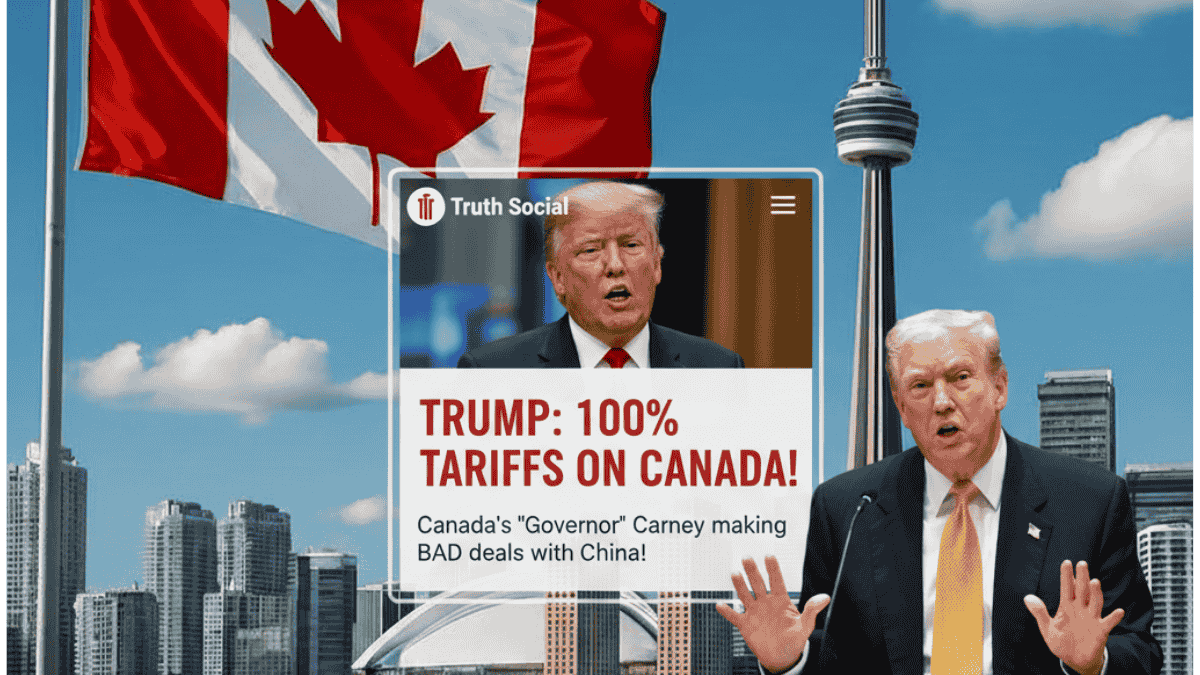
OTTAWA – The long-standing “special relationship” between Canada and the United States has hit a freezing point this Sunday. Following a weekend of explosive rhetoric from Washington, Prime Minister Mark Carney has issued a rallying cry to the nation, urging citizens to “buy Canadian” to shield the domestic economy from what he describes as unprecedented “threats from abroad.”
The sudden escalation follows a social media firestorm from U.S. President Donald Trump, who on Saturday threatened to slap a 100% tariff on all Canadian goods entering the United States. The catalyst? A landmark trade agreement between Canada and China that aims to lower barriers on everything from electric vehicles (EVs) to canola.
The “Governor” vs. the Prime Minister
In a series of posts on Truth Social, President Trump did not mince words, referring to the Canadian leader as “Governor Carney”—a dismissive jab suggesting Canada is little more than an American territory. Trump warned that China would “eat Canada alive” and claimed that Carney was attempting to turn the country into a “drop-off port” for Chinese products to bypass American trade laws.
“If Canada makes a deal with China, it will immediately be hit with a 100% tariff against all Canadian goods and products coming into the U.S.A.,” Trump wrote.
The Prime Minister’s response, delivered in a pre-recorded video shared across social media, was measured but firm. Opting not to mention Trump by name, Carney focused on economic resilience.
“We’re buying Canadian, and we’re building Canadian,” Carney said, standing before a backdrop of the Parliament buildings. “With our economy under threat from abroad, Canadians have made a choice: to focus on what we can control. We can’t control what other nations do, but we can be our own best customer.”
The Deal at the Center of the Storm
The controversy stems from Carney’s recent state visit to Beijing and his subsequent speech at the World Economic Forum in Davos. The “preliminary agreement-in-principle” with China marks a significant pivot in Canadian trade policy, designed to diversify Canada’s export markets and reduce its overwhelming dependence on the U.S.
Key components of the Canada-China deal include:
- EV Quotas: Canada will lower its 100% surtax on Chinese electric vehicles to just 6.1%, allowing an annual allotment of 49,000 vehicles.
- Agricultural Relief: In exchange, China will slash retaliatory tariffs on Canadian canola seeds (down to 15%), lobster, crab, and peas—a massive win for Prairie farmers and Atlantic fishers.
- Manufacturing Inputs: Extension of tariff remissions for Chinese steel and aluminum products that are currently in short supply within Canada.
Critics in the U.S. see this as a betrayal of the continental trade bloc, while Canadian officials argue it is a necessary “recalibration” for a “new world order.”
Economic Fallout: A High-Stakes Poker Game
For Canada, a 100% tariff is not just a trade barrier; it is an existential threat. The U.S. currently buys roughly 75% of all Canadian exports. If Trump follows through, the impact on sectors like automotive, energy, and lumber would be catastrophic.
However, economists warn that the “100% threat” is a double-edged sword. American consumers would see the price of Canadian-made auto parts, crude oil, and electricity double overnight.
“Yes, he’s hurting Canadian businesses, but he’s hurting U.S. consumers more,” says Preetika Joshi, an assistant professor at McGill University. “The supply chains are too integrated to simply flip a switch without causing massive inflation in the United States.”
Industry Reactions: Relief and Terror
Across the country, the reaction is a mix of patriotic resolve and deep-seated anxiety. In Saskatchewan, Premier Scott Moe hailed the China deal as “great news” for farmers who have been struggling under Chinese retaliatory measures since 2024.
“This progress shows what can be achieved when we work together to strengthen trade relationships,” Moe stated. Yet, the looming threat of U.S. retaliation has many business owners in southwestern Ontario—where the auto sector is most vulnerable—fearing a return to the “stagflation” currents of 2025.
The “Buy Canadian” Movement
Carney’s “Buy Canadian” strategy is more than just a slogan; it is a calculated attempt to stimulate internal demand as external markets become volatile. The policy encourages federal and provincial procurement to prioritize local suppliers and urges consumers to check labels at the grocery store.
“We will buy Canadian. We will build Canada. And together, we will build Canada strong,” Carney concluded in his address.
What Happens Next?
The timing of this dispute is particularly sensitive as the Canada-U.S.-Mexico Agreement (CUSMA) is scheduled for a formal review later this year. Trump’s threats could be a high-pressure negotiating tactic to force Canada to scrap its China deal before CUSMA talks begin.
For now, the Canadian government maintains there is no intent to pursue a full “free trade agreement” with China, only to “rectify issues” that have hampered Canadian exports. Whether that distinction will satisfy a White House focused on “America First” remains to be seen.
As the sun sets in Ottawa, the message to Canadians is clear: the era of predictable trade is over. The country is being asked to hunker down, look inward, and prepare for a trade war that could define the next decade of North American relations.
Leave a Reply