

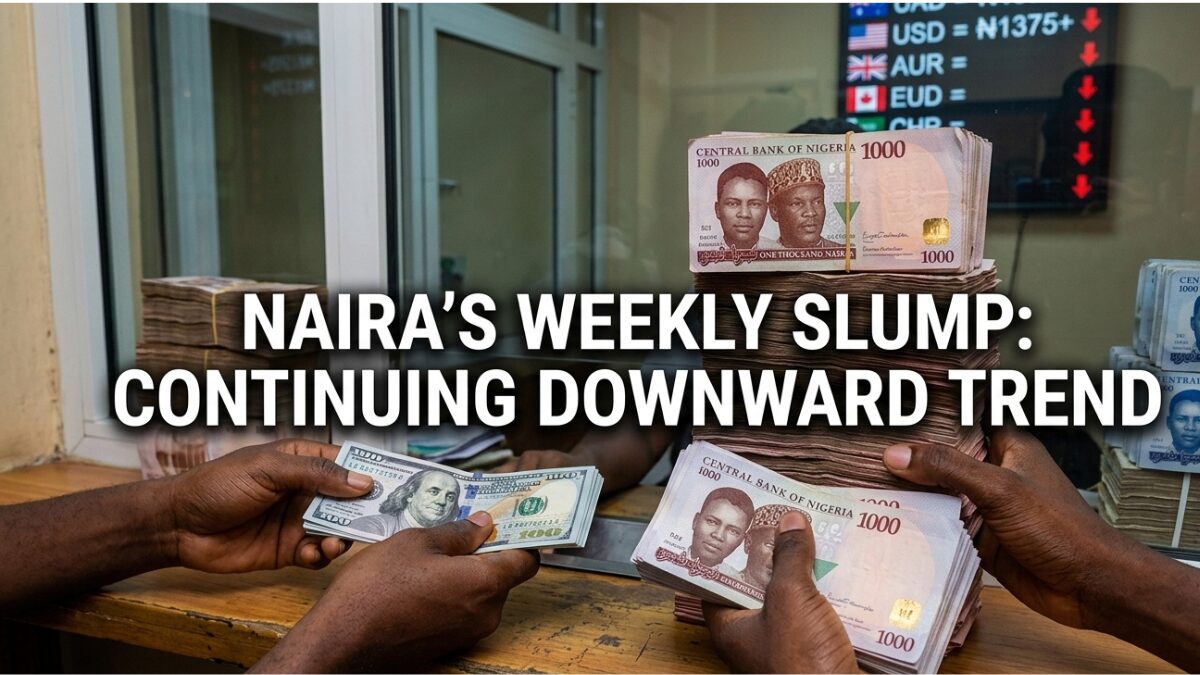
The closing days of February 2026 have brought a familiar sense of anxiety to the Nigerian financial landscape. For many Nigerians, the exchange rate isn’t just a number on a screen; it is a direct driver of the price of bread, the cost of transportation, and the viability of small businesses. As of Friday, February 28, 2026, the Nigerian Naira recorded a massive weekly depreciation against the United States Dollar, hitting significant lows in both the official and parallel (black) markets.
This sudden downturn comes at a time when the government has been projecting optimism about the “reclaiming” of the Naira’s value. However, the reality at the Bureau De Change (BDC) stands and the Nigerian Foreign Exchange Market (NFEM) tells a more complex story. This week, the Naira didn’t just stumble; it retreated significantly, leaving analysts and citizens alike asking: What exactly is happening behind the scenes at the Central Bank?
Breaking Down the Numbers: A Week of Retreat
The data provided by the Central Bank of Nigeria (CBN) and market trackers paints a stark picture of the week’s performance. On Friday, the local currency weakened at the official window to N1,363.39 per dollar. This was a step down from the N1,359.81 recorded just 24 hours earlier on Thursday. While a daily decline of N3.57 might seem manageable in isolation, the cumulative weekly loss tells a different story: a depreciation of N17.07 against the greenback at the official window.
However, the “street” market—the parallel market—felt the sting even more sharply. Week-on-week, the Naira crashed by a staggering N58. It closed at N1,375 per dollar on Friday, compared to N1,317 recorded just seven days prior. This widening gap between the official and parallel rates often signals a surge in demand that the official channels cannot immediately meet, or perhaps, a strategic shift in how the government is managing liquidity.
The Tinubu Confirmation: The Strategy of “Mopping Up”
One of the most talking points of the week was the confirmation by President Bola Ahmed Tinubu that the Central Bank had intentionally “mopped up” dollars from the market. To the uninitiated, “mopping up” sounds counterproductive. If the Naira is weakening, shouldn’t the government be pumping dollars into the market to strengthen it?
The logic behind this move is layered. According to presidency sources and economic analysts, the Naira had been on a rapid appreciation streak in previous weeks. While a stronger Naira is generally welcomed, a too-fast appreciation can trigger what economists call “profit-taking” by foreign portfolio investors. If the Naira gains value too quickly, investors who brought in dollars when the rate was N1,600 might decide to exit the market now to lock in their gains. This sudden exit would create a massive demand for dollars, potentially crashing the Naira even harder than it is falling now.
By “mopping up” dollars—essentially the CBN buying back dollars from the market—the apex bank is attempting to “moderate” the appreciation. They want a stable Naira, not necessarily a volatile, fast-rising one. The goal is to create a predictable environment for businesses, even if it means allowing the Naira to settle at a slightly weaker point in the short term.
The Paradox of Rising External Reserves
While the Naira is losing value, Nigeria’s “savings account”—the external reserves—is looking healthier than it has in over a decade. As of February 25, 2026, official figures show that Nigeria’s external reserves rose to $49.51 billion. Some reports even suggest it has crossed the $50 billion mark, hitting a 13-year high.
This presents a fascinating economic paradox: Why is the currency falling when the country has more foreign cash in the bank?
- Buffer Building: The CBN, under Governor Olayemi Cardoso, appears focused on building a “war chest.” By allowing the Naira to depreciate slightly while holding onto dollar inflows, the bank is ensuring it has enough liquidity to defend the currency later in the year if a major shock occurs.
- Debt Obligations: 2026 is a significant year for Nigeria’s Eurobond obligations. Major banks like Access, Fidelity, and UBA have significant dollar debts maturing. A healthy reserve ensures that the country and its financial institutions can meet these obligations without a “run on the dollar.”
- Import Cover: With reserves at nearly $50 billion, Nigeria now has almost 10 months of import cover. This is a massive improvement from 2024 levels and provides a safety net for the country’s import-heavy economy.
The Human Perspective: The Kitchen Table Economy
Away from the spreadsheets and the CBN’s “calibrated easing” mode, the depreciation is being felt at the “kitchen table.” For the average Nigerian, the exchange rate is the invisible hand that resets the price of everything.
In early 2026, headline inflation has finally begun to ease, dropping to 15.10% in January from previous highs of over 30% in 2024. However, this progress is fragile. A weekly drop of N58 in the black market exchange rate can quickly reverse these gains. Importers of raw materials, electronics, and food staples like milk and sugar will inevitably adjust their prices to reflect the N1,375 rate, not the N1,317 rate of last week.
“Every time I hear the dollar has gone up, I know my profit margin just got smaller,” says Chinedu, a spare parts dealer in Lagos. “We don’t buy from the CBN; we buy from the street. If the street price hits N1,400, I have to change my price tags immediately.”
This sentiment is echoed across the country. The “Naira stability” that the government touts feels like a moving target to the consumer. While the IMF and Fitch might see “modest depreciation” as a sign of a maturing market, the parent paying school fees abroad or the manufacturer trying to keep the lights on sees it as a persistent hurdle.
The Interest Rate Pivot: CBN’s Balancing Act
This week’s depreciation also follows a landmark decision by the Monetary Policy Committee (MPC). For the first time in years, the CBN actually cut the interest rate, trimming the Monetary Policy Rate (MPR) from 27% to 26.5%.
This move signals a pivot from “aggressive tightening” to “measured moderation.” The bank believes that inflation is finally under control enough to allow for a slight reduction in borrowing costs. Lower interest rates are meant to stimulate the real sector—giving businesses access to cheaper loans to expand and create jobs.
However, there is a risk. Lower interest rates can make Naira-denominated assets (like government bonds) less attractive to foreign investors. If investors feel they aren’t getting enough return for the risk of holding Naira, they might sell their positions and demand dollars. This is part of the “dollar demand” that the CBN is trying to manage by mopping up excess liquidity.
The Road to N1,000: Promise vs. Reality
President Tinubu has frequently reiterated his belief that the Naira will eventually appreciate to N1,000 per dollar. For many, this is the “holy grail” of exchange rates—a level that would significantly lower the cost of living and signal a true economic recovery.
However, institutional analysts are more cautious. Firms like SBM Intelligence project that the Naira will likely trade within a band of N1,470 to N1,520 for much of 2026. Their reasoning is based on the Medium-Term Expenditure Framework (MTEF), which assumes a rate of around N1,512.
The disconnect between the “political” promise of N1,000 and the “economic” forecast of N1,500 creates a gap in public expectation. If the public expects N1,000 but sees N1,375, it can lead to speculative behavior—people holding onto dollars because they don’t believe the currency will actually get stronger.
Political Shadows: 2027 and the Electoral Act
Looking further ahead, the 2027 general elections are already starting to cast a shadow over the economy. The newly signed Electoral Act 2026 has significantly raised the limits for campaign spending. Presidential candidates can now spend up to N10 billion, and donation limits have increased tenfold.
Historically, election cycles in Nigeria are periods of high dollar demand. Politicians and parties often “mop up” dollars to fund their campaigns, leading to artificial scarcity. The Central Bank is acutely aware of this “election-spending risk.” By mopping up dollars now and building reserves, they are preparing for the inevitable liquidity surge that 2026 and 2027 will bring.
Conclusion: A Cautious Outlook
As we head into March 2026, the Naira’s path remains a delicate balancing act. On one hand, the “fundamentals” are stronger than they have been in years:
- External Reserves: Highest in 13 years ($49.51bn+).
- Inflation: On a downward trend (15.10%).
- Refining Power: The Dangote Refinery is scaling up to 700,000 bpd, drastically reducing the need to export dollars for fuel imports.
- Bank Recapitalization: 20 out of 33 banks have already met new capital requirements, creating a more robust financial system.
On the other hand, the weekly depreciation reminds us that market sentiment is fickle. The “mopping up” strategy shows that the government is more concerned with stability than rapid appreciation. They are willing to let the Naira lose some ground now to prevent a catastrophic crash later.
For the Nigerian citizen, the message is one of cautious patience. The days of N1,600/$ might be behind us, but the road to N1,000/$ is paved with technical adjustments, liquidity mops, and global oil price fluctuations. In the meantime, the “massive weekly depreciation” serves as a stark reminder that in the world of Nigerian forex, the only constant is change.
Key Takeaways for Businesses and Investors:
- Stability over Strength: Expect the CBN to prioritize a steady rate over a fast-appreciating one.
- Reserve Strength: Rising reserves suggest the CBN has the “firepower” to prevent a massive devaluation, even if modest weekly slides occur.
- Inflation Lag: Even as inflation eases, exchange rate volatility can cause “price stickiness” in the markets.
- Election Pressure: Keep an eye on 2027 campaign spending as a primary driver of black market rates later this year.
Nigeria’s economic ship is navigating through calmer waters than in 2024, but the waves of currency depreciation haven’t completely settled yet. The key will be whether the “buffers” being built today can withstand the “spending” of tomorrow.